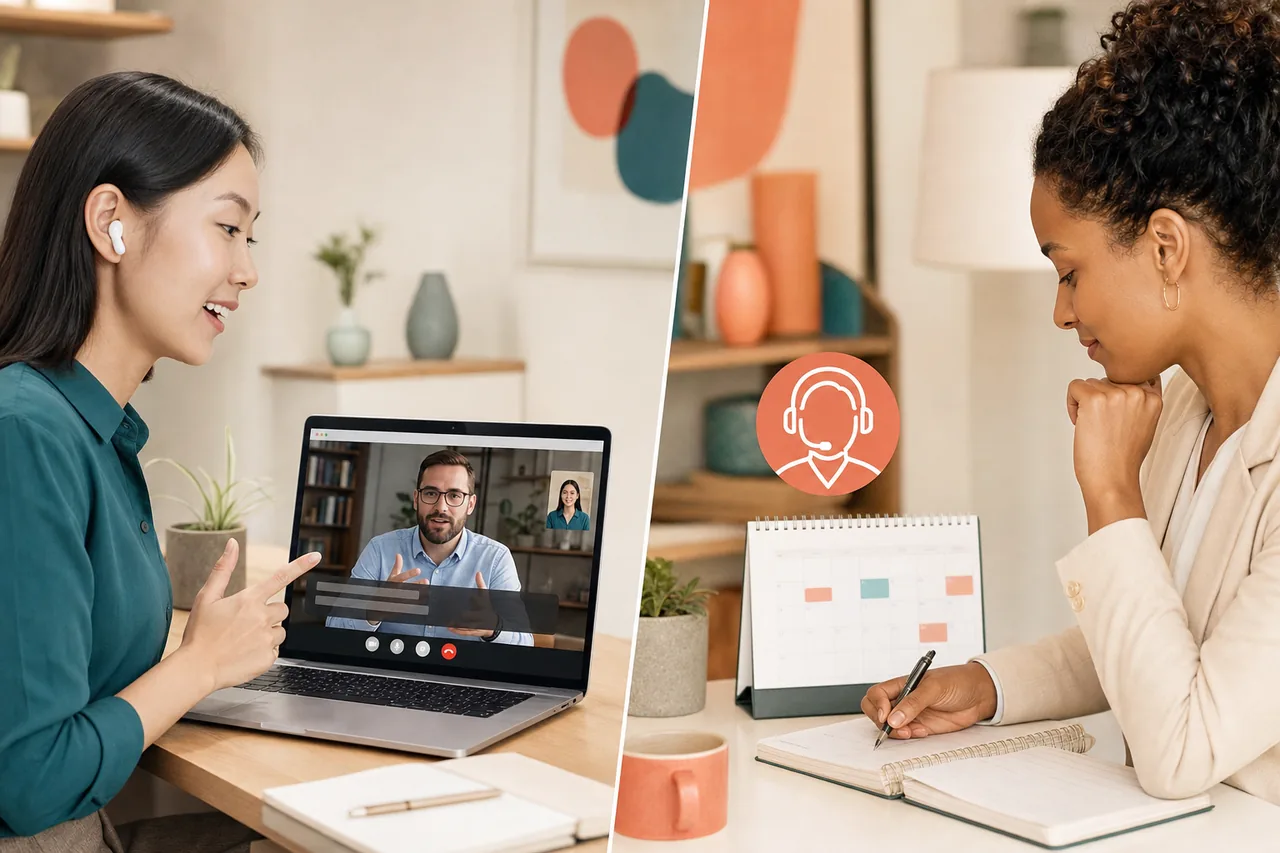
Short answer: choose KUDO when the multilingual moment is a presentation — a webinar, a training, a town hall, a council meeting — or when the stakes justify booking professional human interpreters, including sign languages. Choose Talkniva when the moment is a conversation: two or three people on a call, each speaking and needing to hear the others in their own language, bought online without a sales process.
The line between them is drawn by KUDO itself: its FAQ describes KUDO AI’s presentation mode as translated audio plus captions, and its conversational mode as ultra-fast translated captions only.
Talkniva vs KUDO at a glance
| KUDO | Talkniva | |
|---|---|---|
| Built for | Webinars, events, training, all-hands, plus human interpretation | Two-way business calls and small meetings |
| AI output | Presentation mode: translated audio + captions; conversational mode: captions only | Translated voice, camera and captions for each active guest |
| Human interpreters | 12,000+ to book on demand; 200 spoken and sign languages | None — AI only |
| AI languages | More than 70 | 13 |
| Scale | Up to 3,000 users per language, per meeting or event | Small calls; billed per active guest |
| Platforms | Own platform; native Microsoft Teams integration; widget for Zoom and others; Google Meet integration announced | Own browser room by link; beta interpreter that joins Teams, Meet or Zoom |
| Pricing | Annual plans from 50 hours/year or pay-as-you-go credits; price set by usage, not published | Published prepaid packs: US$7.60 (20 min) to US$133 (10 h); no subscription |
| After the session | Recordings downloadable in each language | Nothing recorded or stored |
When KUDO is the better choice
- One person talks, many listen. In presentation mode, KUDO AI delivers translated audio and captions, and each participant picks the language to follow from a laptop or phone. With up to 3,000 users per language per meeting, it handles audiences Talkniva is not built for.
- The conversation is high-stakes and needs people. Board negotiations, legal or medical sessions, diplomatic meetings: KUDO lets you book professional interpreters from a pool of more than 12,000, or bring your own, and covers 200 spoken and sign languages. Talkniva has no human interpreters.
- You need sign language or a rare language. KUDO’s human service includes sign languages and dialects; its AI covers more than 70 languages against Talkniva’s 13.
- You want recordings afterwards. KUDO lets you download recordings in each language. Talkniva deliberately records nothing.
- Your organisation standardises on Microsoft Teams. KUDO describes a native Teams integration and an embeddable widget for other platforms, backed by an in-house support team you can buy credits for.
When Talkniva is the better choice
- Everyone in the call talks. In a Talkniva room each active guest gets their own real-time translated voice channel, with camera and captions. A buyer in Madrid and a supplier in Seoul both speak and both hear — spoken translation in both directions, not captions to read.
- You want to buy it today, not after a demo. Prices are public and self-serve: 20 guest-minutes for US$7.60, a guest-hour for US$19, 5 for US$76, 10 for US$133. KUDO’s plans are annual or credit-based with pricing set by usage through its team.
- The volume is small and you want to buy it yourself. KUDO’s plans are annual (from 50 hours per year) or pay-as-you-go credits, arranged through its team. Talkniva’s packs are bought online in minutes at a published price — a lighter start for a few international calls a month.
- Nothing should be kept. Talkniva does not record or store call audio, video or transcripts — useful for negotiations and interviews where a recording is a liability.
The decisive difference: which mode gets the voice
Both products translate speech with AI, so the useful question is who hears a translated voice, and when.
KUDO’s AI puts translated voice in presentation mode, where speakers present and participants follow. In its conversational mode — the one meant for back-and-forth — KUDO AI delivers captions only, prioritising speed. For spoken conversation in both directions, KUDO’s answer is its human interpreters, booked with at least a two-hour lead time.
Talkniva is built the other way round: the conversation is the default. Every active guest receives translated voice as the other person speaks, in both directions, with captions alongside. The cost of that design is scale and reach — 13 languages, no human interpreters, and pricing that grows with each active guest rather than covering a 3,000-person audience.
So: presentation or event → KUDO AI. High-stakes conversation that needs people → KUDO’s interpreters. Everyday two-way call with AI voice → Talkniva.
Three meetings, one company
A logistics company works across Brazil, Spain and South Korea.
- Its quarterly safety training for 600 warehouse staff is KUDO AI’s case: the trainer presents in Portuguese and staff follow in Spanish or Korean audio on their phones.
- The contract renegotiation with its Korean partner, with lawyers on both sides, is a case for KUDO’s professional interpreters.
- The weekly 30-minute operations check-in between the São Paulo manager and the Busan site lead is Talkniva’s case: one room link, translated voice both ways, and 30 guest-minutes from a prepaid pack.
Related guides
- KUDO’s place among desktop tools, meeting bots and platform features: the best live translation apps for work calls.
- Deciding between software and people in general: real-time translator vs human interpreter.
- Another event-first tool compared: Talkniva vs Wordly.
Need translated voice in a two-way call? Create a room or see guest-hour pricing.
Frequently asked questions
Does KUDO AI translate conversations by voice?
KUDO’s own FAQ says KUDO AI runs in two modes: presentation mode, with translated audio and captions, and conversational mode, with fast translated captions only. For spoken, multi-way conversations KUDO points to its human interpretation service, with 200 spoken and sign languages.
How does KUDO pricing work compared with Talkniva?
KUDO’s plans page lists annual plans starting from 50 hours per year and pay-as-you-go credits, with cost set by usage; no public price is shown. Talkniva publishes its prices: prepaid guest-hours from US$7.60 for 20 minutes to US$133 for 10 hours, with no subscription.
Is KUDO or Talkniva better for a one-to-one business call?
For a two-person call where both sides need to speak and hear their own language, Talkniva is designed for that case and is bought self-serve. KUDO fits webinars, training, town halls and events, or high-stakes conversations where you want to book professional human interpreters.
How many languages do KUDO and Talkniva support?
KUDO lists more than 70 languages for KUDO AI and 200 spoken and sign languages through human interpreters. Talkniva translates voice in 13 languages.