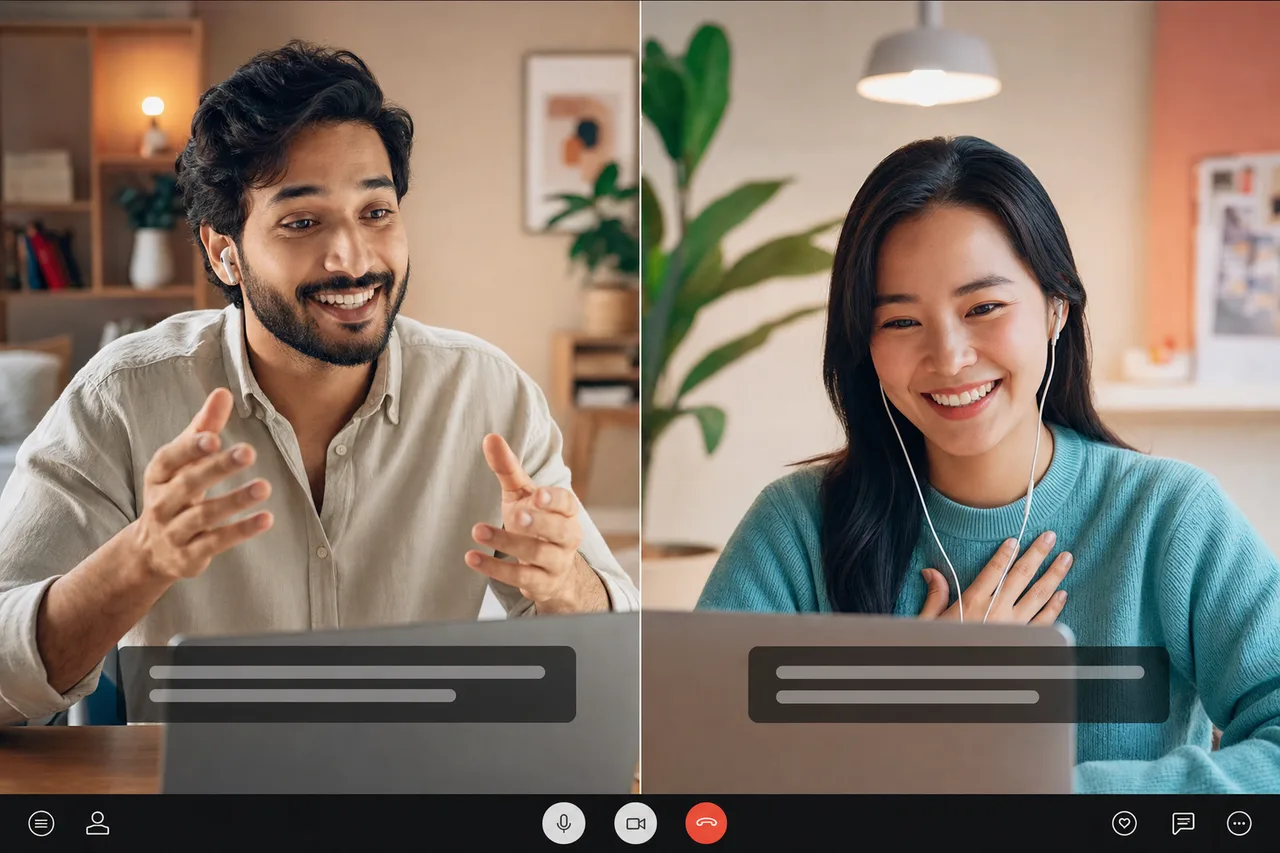
Microsoft Teams real-time translation does exist, but it works in one specific way: as live translated captions — text you read on screen while someone speaks. You turn on captions, set the spoken language, then pick a language to translate them into, and everyone reads along in their own tongue. It’s genuinely useful for following a meeting. But before you build a multilingual call around it, there’s a limit nobody mentions, and it changes whether Teams is the right tool at all.
Below: the real steps to switch it on, the catch most guides skip, and when a speech-to-speech translator fits better.
How Microsoft Teams real-time translation actually works
What Teams calls translation is live translated captions. Here’s how to translate Microsoft Teams in a meeting into another language:
- Join or start the meeting, then open More actions (the
...menu) and turn on Live captions. - To the right of the captions, select Caption settings, then Language settings.
- Confirm the Meeting spoken language is correct — this is the language people are actually speaking. Get it wrong and the captions read as nonsense.
- Turn on the Translate to toggle.
- Choose your target language from the dropdown. Captions now appear translated, live, for you.
That’s it. Each person can pick their own target language, so on a good call everyone reads captions in the language they understand while the speaker keeps talking normally. Teams live translated captions support a wide range of languages, and basic, untranslated captions are available for a wide range of spoken languages, often even on free accounts.
So far, so good. Now the parts that trip people up.
The limit nobody mentions
It’s text to read, not a translated voice. This is the big one. Teams real-time translation gives the listener captions to read. The other person still hears your original audio — your actual voice in your actual language. There is no translated voice being spoken to them. If your counterpart is comfortable reading fast English while you talk, fine. If they need to hear it in Spanish or Japanese, captions don’t deliver that. You’re both reading subtitles on a call instead of talking.
It usually needs a paid plan. Plain captions are free. Translated captions generally are not — live translated captions usually sit behind a paid Teams tier or add-on license on top of your existing subscription. The licensing has a wrinkle worth knowing: if the meeting organizer holds the right license, every participant in that meeting can often use translated captions. But if only individual people are licensed, only those people see the Translate to option. So whether translation “works” can depend on who set up the meeting, not who needs it.
External guests can’t just join a translated call by link. Teams is built around accounts and org licensing. You can’t hand an outside client a plain link and expect them to drop into a fully translated experience with no friction. They land in the platform’s account-and-license world, and what they get depends on how your tenant is set up — not on a one-click invite.
None of this makes Teams translation bad. It makes it a reading aid for a meeting you’re already running in Teams — not a way to actually talk across a language gap. The same pattern holds for Google Meet’s native translation: captions to read along, not a translated voice for the other side.
When a speech-to-speech translator fits better
Here’s the honest dividing line. Use the platform’s captions when everyone can read the other language and you just want to follow a group meeting. Reach for a speech-to-speech tool when someone actually needs to hear the conversation in their language and reply by voice — a sales call, a support session, an interview, a first conversation with a partner abroad.
That’s where Talkniva is built differently. Its beta meeting interpreter brings two-way translated voice to an existing Teams meeting. Paste the meeting link in Talkniva, choose the two languages, and a bot identified as a Talkniva interpreter joins as a participant. The host speaks and listens through the Talkniva browser tab; everyone else remains in Teams and does not install a Talkniva plugin or create a Talkniva account.
This is not an overlay that changes the Teams interface: the interpreter is a visible meeting participant. Depending on the organizer’s policy, it may wait in the lobby until someone admits it. The external-meeting mode is voice-only — it does not add Talkniva captions or translated video to Teams. If the host also wants video, they can keep Teams open in another tab with that tab’s microphone and audio muted to avoid echo. The meeting interpreter supports a configured pair chosen from 13 spoken languages, uses prepaid minutes, and does not record or store call audio, video, or transcripts.
Because the integration is in beta, test it before a critical meeting and keep a fallback. The host must also have permission to bring an interpreter and inform the participants that the Talkniva interpreter processes the meeting audio.
The short version
- Teams real-time translation = translated captions. Text to read, switched on under Caption settings → Language settings → Translate to.
- It usually needs a paid tier or add-on license (often via the organizer’s license), and it won’t give the other side a translated voice or an easy join-by-link for outside guests.
- For reading along, Teams captions do the job. For two-way translated voice, Talkniva’s beta interpreter can join the Teams meeting as a participant while the host speaks and listens through Talkniva.
If your next Teams call hinges on being heard in someone else’s language, sign in to Talkniva, choose the meeting option, paste the link, select the two languages, and accept the beta and participant-consent conditions. Then admit the named interpreter if Teams places it in the lobby. Start now.
Frequently asked questions
Does Microsoft Teams have real-time translation? Yes, in the form of live translated captions. You turn on captions, set the spoken language, then choose a language to translate them into, and the captions appear on screen in that language while the person speaks. It translates text to read, not the speaker’s voice.
How do I translate Microsoft Teams into another language? In the meeting, open More actions and turn on Live captions. Then select Caption settings, then Language settings, confirm the Meeting spoken language, switch on the Translate to toggle, and pick your target language. Each person can choose their own. This gives you translated captions to read, not a translated voice.
Do you need a paid plan for Teams live translated captions? Usually, yes. Basic captions are free, but translated captions generally require a paid Teams tier or add-on license. Often, if the meeting organizer is licensed, all participants can use them; otherwise only licensed individuals see the Translate to option.
Does Teams translation give the other person a translated voice? Teams’ native translation does not: it provides translated captions to read. For translated voice, Talkniva’s beta meeting interpreter can join the Teams meeting as a named participant and carry audio both ways while the host speaks and listens in the Talkniva browser tab.
Can an external guest join a translated Teams call by link? A guest can join Teams by link, but access to native translated captions depends on the tenant and licensing. With Talkniva’s beta interpreter, participants remain in Teams and install nothing from Talkniva; a named interpreter bot joins the meeting and may need to be admitted from the lobby.