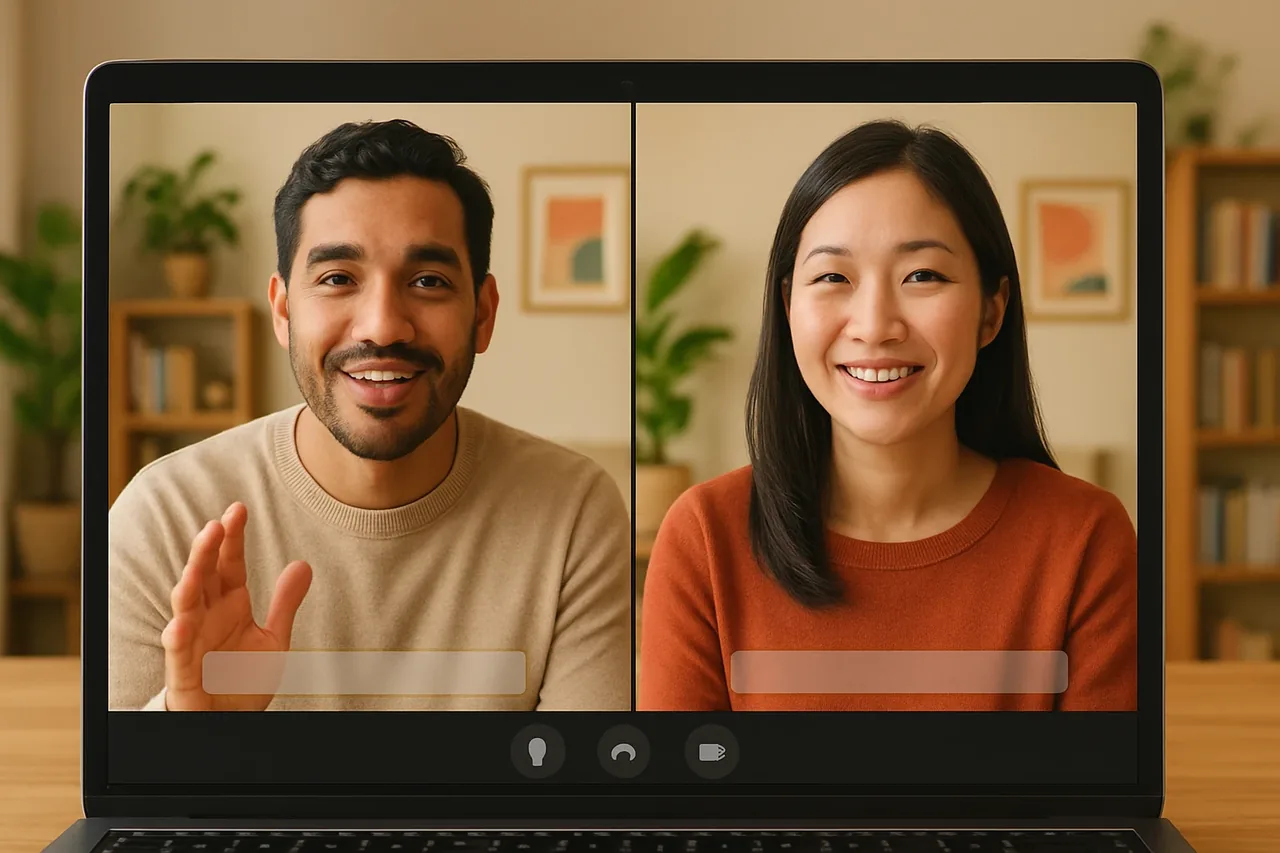
Short answer: to run a sales discovery call with a prospect who speaks another language, meet in a Talkniva room so each of you speaks your own language and hears the other translated live. Then do the work of a good discovery call: open with the purpose, ask a few qualifying questions, repeat what you heard, handle objections calmly, and end by agreeing a next step and sending it in writing.
The problem
A first call is where you learn whether there is a fit: what the prospect needs, by when, who decides and what stands in the way. If you don’t share a language, that learning is slow and easy to get wrong, and the prospect may hear a rushed, half-understood pitch instead of a conversation.
Translated live voice lets the conversation flow. It does not qualify the prospect for you, so the structure of the call still matters.
The discovery call in 4 steps
1. Invite and set the purpose
Send the link with the time and one line on what the call is for. The prospect opens it in a browser, picks their language and joins, with no sign-up and nothing to install. Check the pair you need on the supported languages page. Start the call by saying what you want to learn and how long it will take.
2. Ask a few qualifying questions, one at a time
Keep a short list: what the prospect is trying to do, what they use today, who else is involved, when they need it, and what a good result looks like to them. Ask one question, then wait for the full answer before the next. Use the captions to check names, figures and dates as they come up.
3. Repeat what you heard and handle objections
After each answer, say it back in one sentence and let the prospect correct you. When an objection comes up, restate it before you respond: “You’re worried about X. Is that right?” Hearing the concern in their own words matters more than a quick reply, and you should not promise an outcome you cannot guarantee.
4. Agree the next step, then recap in writing
Finish with a concrete next step: who does what and by when. Talkniva does not record or store calls, audio, video or transcripts, so your notes are the record. Within the day, email the prospect a recap with their needs as you understood them, any objections raised and the agreed next step, and ask them to confirm or correct it.
What it costs
Consumption is counted in guest-hours from a prepaid pack, with no subscription and no free trial. The meter follows the prospect on the call, so 30 minutes with one prospect uses 30 minutes. The pricing page lists the current packs.
Frequently asked questions
What does the prospect have to do to join the call? Open your link in a browser, pick a language and join. There is no sign-up and no software to install.
Which languages are available for sales calls? Thirteen: English, Portuguese, Spanish, French, German, Italian, Japanese, Korean, Chinese, Russian, Hindi, Indonesian and Vietnamese. The supported languages page has the list.
Will the call be recorded for my CRM? Talkniva does not record or store calls, audio, video or transcripts. Write your notes during the call and add them to your CRM afterwards.
Do I pay per call or per month? Neither. You buy a prepaid pack of guest-hours, with no monthly plan and no free trial. The prospect’s time on the call is what is counted: 30 minutes with one prospect is 30 minutes.
My prospect already uses Teams, Meet or Zoom. Can I keep that? There is a beta integration: paste the meeting link and the Talkniva interpreter joins as a participant. Because it is beta, it can be unstable. Warn the participants an interpreter is about to join and admit it from the waiting room if there is one.
Ready for your next discovery call?
Create a live translation room, send the link and start the conversation in your own language.
Related reading
Sources
[1] Talkniva supported languages: the 13 languages (accessed November 1, 2026). [2] Talkniva pricing page: usage unit, packs and consumption per active guest (accessed November 1, 2026).